Slip resistance and workplace safety for commercial and industrial epoxy floors
By Hannah Nair · Updated 2026-07-25
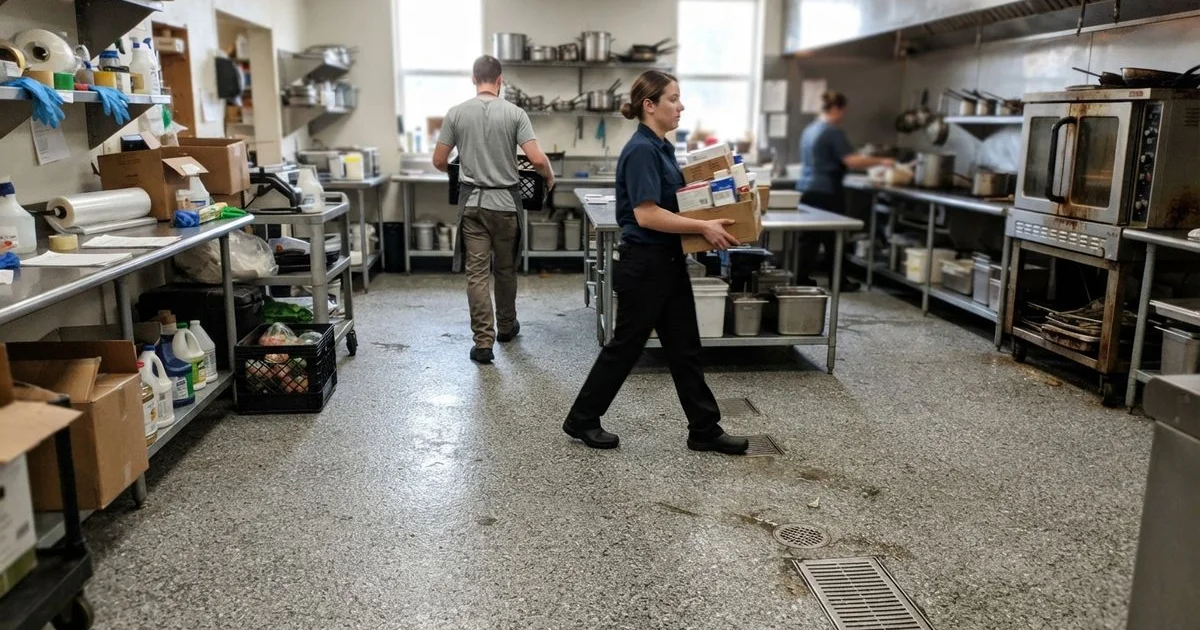
A commercial or industrial floor that looks polished and impressive can also be a liability if it does not hold traction where it matters. Slip and fall incidents are one of the more common workplace injury categories, and flooring choice is a real, addressable factor in reducing that risk.
This is general safety information, not a substitute for a workplace safety assessment specific to your facility. For formal compliance guidance, consult Ontario’s Occupational Health and Safety Act resources or a workplace safety consultant.
How epoxy floors get their traction
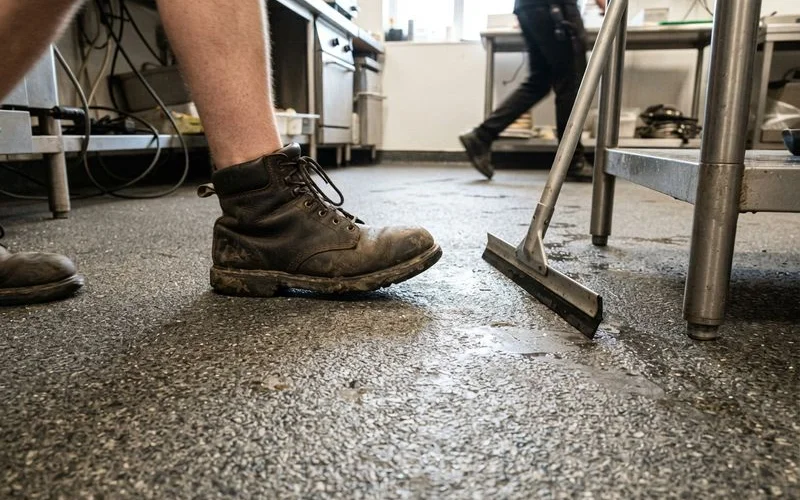
A standard glossy epoxy topcoat is smooth, which looks clean but offers limited grip, especially once water, oil, dust, or any residue sits on the surface. To add traction, installers broadcast an aggregate, commonly fine silica sand, aluminum oxide grit, or a polymer bead, into the final coat or a dedicated non-slip layer before the topcoat cures. The result is a surface with microscopic texture that maintains grip underfoot even when wet.
The amount and grit size of the aggregate determines how aggressive the texture is. A light broadcast gives subtle traction suitable for moderate-risk areas; a heavier, coarser broadcast is used in high-risk zones like commercial kitchens or wash-down areas where water and grease are constant.
Where slip resistance matters most
| Facility type | Slip risk level | Typical need |
|---|---|---|
| Dry office or retail floor | Low | Standard finish usually sufficient |
| Warehouse with forklift traffic | Moderate | Textured finish recommended, especially near loading areas |
| Manufacturing floor with fluid exposure | High | Aggressive texture, often paired with chemical-resistant topcoat |
| Commercial kitchen or wash-down area | Very high | Heavy-grit non-slip coating, often mandatory by insurer or code |
| Parkade or ramp | High, especially wet/icy conditions in winter | Textured finish critical for vehicle and foot traffic |
The trade-off with texture
More traction generally means a rougher surface, which can be marginally harder to clean and, in very high-grit applications, slightly harder on wheeled equipment like carts or forklifts over time. A good installer will match the grit level to the actual risk in each zone of a facility rather than applying the heaviest texture everywhere by default, since an overly aggressive texture in a low-risk office corridor adds cost and cleaning difficulty without a real safety benefit.
What to ask an installer
Ask specifically what aggregate and grit level they recommend for each zone of your facility, and why. A contractor who assesses your specific traffic and liquid exposure patterns, rather than offering one standard texture for the whole floor, is doing the job properly. Also ask how the slip-resistant coating holds up to your facility’s cleaning routine and chemicals, since some cleaning agents can degrade certain coating types faster than others.
Ask, too, about colour contrast and zone marking. Many facilities use coating colour changes to mark walkways, forklift lanes, and hazard areas, which is a separate safety layer from traction but often installed at the same time by the same crew. A facility manager planning a floor project is usually better off addressing traction and wayfinding together rather than treating them as separate projects down the line.
Downtime during a facility recoat
Slip-resistant coatings eventually wear, especially in high-traffic zones where the aggregate gets worn smooth over years of forklift and foot traffic. Planning a recoat before the texture is visibly gone matters, since a worn-smooth zone loses its slip resistance well before it looks obviously bad. For a facility that cannot fully shut down, ask installers about phased recoating, working section by section, or scheduling around planned shutdowns, since a polyaspartic system’s faster cure can shrink the downtime window considerably compared to standard epoxy on a large industrial floor.
Documenting your safety measures
If your facility has any history of slip incidents or handles fluids regularly, keep records of the flooring specification chosen and why, alongside your broader workplace safety documentation. This matters both for genuine safety and for demonstrating due diligence if an incident is ever reviewed. The commercial and industrial flooring category on the Ontario Epoxy Flooring Directory lists installers experienced with facility-specific safety coatings, and our methodology explains how those listings are rated.
FAQ
- How does an epoxy floor become slip-resistant?
- Installers broadcast an aggregate, usually fine silica sand or aluminum oxide grit, into the final coat or a dedicated texture layer. This creates a slightly rough surface underfoot that maintains traction even when wet or oily, unlike a smooth glossy topcoat.
- Do all commercial or industrial floors need slip-resistant coatings?
- Not all, but any space with regular exposure to water, oil, grease, or other liquids, kitchens, warehouses handling fluids, manufacturing floors, benefits significantly. Dry retail or office spaces have less need for aggressive texture.
- Is a glossy epoxy floor unsafe?
- Not inherently, but a smooth glossy finish offers less traction than a textured one, especially once any moisture, dust, or residue is on the surface. For high-traffic commercial spaces with any liquid exposure, most safety-conscious facility managers choose a textured or matte finish over high-gloss.
- Are there workplace safety standards for floor slip resistance in Ontario?
- Ontario's Occupational Health and Safety Act requires employers to maintain a safe workplace generally, which includes floor conditions, though it does not specify a single numeric slip-resistance standard for coatings. A facility with known slip risks should document the steps taken to address them, including flooring choices.