Contracts and warranties: what to check before hiring an epoxy flooring contractor
By Hannah Nair · Updated 2026-07-05

Most complaints about epoxy flooring jobs are not really about the epoxy. They are about a promise that was made verbally, never written down, and then disputed once the floor started showing problems. A clear written contract and warranty do not guarantee a perfect job, but they give you something to point to if one goes wrong.
This guide covers general information about what to look for in a contract, not legal advice specific to your situation. For a dispute involving real money, a paralegal or lawyer familiar with Ontario consumer protection law can advise on your specific options.
What a proper contract should include
A written contract, not just an emailed quote, should spell out the scope of work in enough detail that there is no ambiguity later about what was included.
- Exact square footage and areas covered, so there is no dispute about whether a side wall or a step counts as part of the job.
- The specific coating system and number of coats, by product name if possible, not just “epoxy.”
- Surface prep included, grinding, crack repair, moisture testing, and what happens if hidden damage is found once prep starts.
- Total price and payment schedule, including deposit amount and when the balance is due.
- Start date and expected completion timeline.
- Warranty terms, in writing, not a verbal assurance.
What a real warranty looks like
| Warranty element | What to look for | Red flag |
|---|---|---|
| Coverage | Adhesion failure, peeling, delamination named specifically | Vague “satisfaction guaranteed” with no specifics |
| Duration | Stated in years, in writing | “As long as it’s needed” with no fixed term |
| What’s covered | Material and labour to fix a covered failure | Material only, you pay labour to fix their error |
| Exclusions | Normal wear, misuse, or damage from vehicles/chemicals | No exclusions listed at all, which usually means none apply in practice |
| Transferability | States whether it transfers if you sell the home | Not addressed |
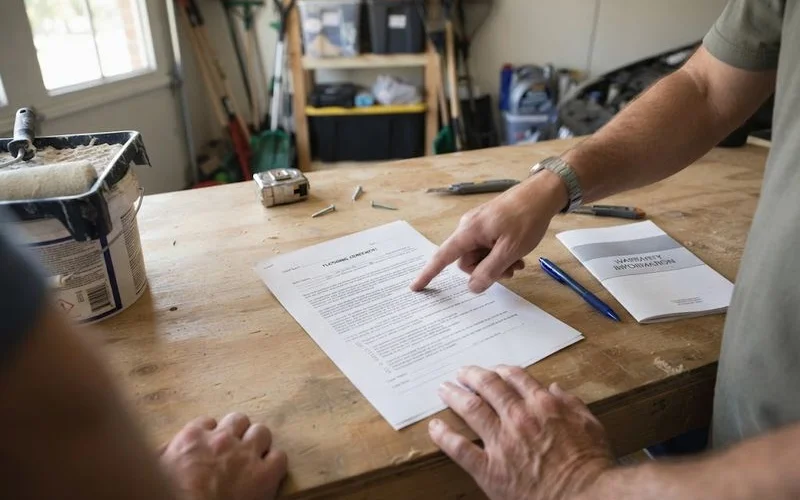
Why this matters more than it seems to at the outset
A recurring theme in installer reviews across this niche is a floor that developed problems, peeling, scratches, or an uneven finish, months after completion, followed by a contractor who was slow to respond or did not honour what was discussed at the time of the sale. None of this is unique to epoxy flooring, it happens in any trade, but a written contract and warranty are what separate a fixable disagreement from a total loss. Without documentation, it becomes your word against theirs about what was promised.
Questions worth asking before you sign
Ask directly whether the warranty covers labour or just materials, since a material-only warranty can still leave you paying hundreds of dollars to have a failed floor fixed. Ask how disputes get resolved if the installer disagrees the failure is their fault. And ask for references from jobs completed at least a year ago, not just recent ones, since some coating failures only show up after a full season of use.
If something does go wrong
Document the problem with photos and dates, and reach out to the installer in writing (email, not just a phone call) describing the issue and referencing your contract’s warranty terms. Keep records of every exchange. If the installer is unresponsive, Ontario’s Consumer Protection Act gives homeowners some recourse for services not delivered as agreed, though the specifics depend on your situation, and a paralegal can advise on next steps.
Checking references before you sign, not after
A phone call to two or three past customers, ideally ones whose jobs finished at least a year earlier, tells you more about how an installer handles a warranty claim than any sales conversation. Ask those references directly whether anything went wrong and, if so, how the installer responded. An installer who happily connects you with older jobs, not just their newest project, is signalling confidence in how their work holds up.
Choosing a contractor with a track record of honouring warranties in the first place, which you can check through the Ontario Epoxy Flooring Directory and its methodology for how ratings account for this, is the easier problem to solve upfront.
FAQ
- What should an epoxy flooring warranty cover?
- A solid warranty covers adhesion failure (peeling, lifting) and defects in the coating material for a set number of years, typically 1 to 5 depending on the product and installer. Ask specifically whether labour to fix a failure is included or only the material.
- Is a verbal quote or handshake agreement enough?
- No. Get the scope of work, materials, coats, prep steps, price, and warranty terms in writing before any work starts. A verbal agreement gives you nothing to point to if the installer's account of what was promised differs from yours later.
- What if a contractor won't put their warranty in writing?
- Treat that as a red flag. A legitimate installer with confidence in their work will provide written warranty terms without hesitation. Reluctance to document it usually means the warranty is informal at best.
- Does a deposit protect me or the contractor?
- A reasonable deposit, often a third or less of the total, is normal and protects the contractor's material costs. A demand for full payment upfront protects neither party well and is worth questioning before you sign.